Beyond Burke
Pan-Atlantic conservative responses to the French Revolution remain woefully understudied. Historiographical rehabilitation is crucial — and carries implications well beyond the academy.

“Perhaps other circumstances, not known in this country, may serve to palliate the apparent cruelty of the ruling faction. But there are some proceedings of the present convention, which admit of no excuse but a political insanity; a wild enthusiasm, violent and irregular, which magnifies a mole-hill into a mountain; and mistakes a shadow for a giant.” - Noah Webster, The Revolution in France, 1794
“What distinguishes the French Revolution and makes it an event unique in history is that it is radically bad. No element of good disrupts the eye of the observer; it is the highest degree of corruption ever known; it is pure impurity.” - Joseph De Maistre, Considérations Sur France, 1797
“The French Revolution therefore began by a violation of rights, every step of its progress was a violation of rights, and it was never easy until it had succeeded to establish absolute wrong, as the supreme and acknowledged maxim of a state completely dissolved and yet existing only in bloody ruins” - Friedrich Von Gentz, The Origin and Principles of the American Revolution, Compared with the Origin and Principles of the French Revolution, 1800
The French Revolution catalyzed conservatism. The violence and political upheaval that accompanied the destruction of the Ancien Regime provoked an array of intellectual opposition across the Atlantic world. Some of the works produced during this period, among them Edmund Burke’s Reflections on the Revolution in France and Joseph de Maistre’s Considerations on France, remain influential today. Others retain little popular acclaim, but offer important insights into how the French Revolution shaped regional conservatisms amidst the so-called “Age of Atlantic Revolutions.” Friedrich Von Gentz’s comparison of the American and French Revolutions and Noah Webster’s analysis of the French Revolution fall into this latter category. Yet the professional historiography of the conservative reaction to the French Revolution remains both limited in scope and tainted by its hostility towards unashamed critics of revolutionary ideals.
In examining the responses of three conservative intellectuals – the Savoyard Joseph De Maistre (1753-1821), the Prussian Friedrich Von Gentz (1764-1832), and the American Noah Webster (1758-1843) – to the French Revolution, it becomes apparent that intellectual opposition to the Revolution was neither as limited nor as unreasonable as traditional historiographic depictions suggest. De Maistre depicted the Revolution as the sweeping hand of Providence and piercingly critiqued the intellectual underpinnings of the French Republic. Gentz contrasted the legality of the American and French Revolutions through the lens of real right. Webster applauded the initial aims of the Revolution but expressed dismay at its tumultuous course. Maistre wrote for the French emigre community, Gentz for the Berlin literary public, and Webster for an American audience that was embroiled in a Federalist-Republican debate inextricably linked to events in France. In short, they made contextual yet principled objections to a revolution that was the defining political event of their time. Acknowledging a coherent, connected, and intellectually respectable conservative response to the French Revolution is crucial for a holistic understanding of this politically tumultuous period. Furthermore, the study of the conservative opponents of the Revolution has serious implications for the broader Atlantic paradigm and, by extension, the nature of the American founding.
I
The mainstream historiography of the French Revolution has borne a distinct distaste for conservatives and counterrevolutionaries. This dynamic began after the Restoration and continued throughout the nineteenth century. The 1889 centenary of the Revolution saw the solidification of the “Republican” viewpoint in the French academy, which, while disavowing the most egregious revolutionary violence, firmly defended the revolutionary project. Interest grew throughout the early twentieth century in the Revolution’s socio-economic aspects, while the onset of the Cold War saw the primacy of Georges Lefebvre’s Marxist school.
Throughout this period, the attitude of the academy towards conservatives and counterrevolutionaries was not only disparaging but distinct. Counterrevolutionary historiography remained on the margins of the historical profession, and still is perceived as a separate field from revolutionary studies. Few studies have been conducted in French or English of the leading conservatives who stood against the Revolution. Instead, the historiographical mainstream has remained fairly content to dismiss revolutionary opponents as dupes at best and fanatics at worst. Owen Bradley – paraphrasing and translating French historian Roger Dupuy – notes how “designations of ignorance and fanaticism, as well as an alleged barbarism or stupidity…are commonly used to lump together and dismiss all resistance to revolutionary progress… [this] corresponds to a profound conviction of a large section of French historiography, which perceives itself to be the heir of enlightenment.” That conservative responses to the Revolution often wholly rejected the revolutionary project was enough to preclude any serious study.
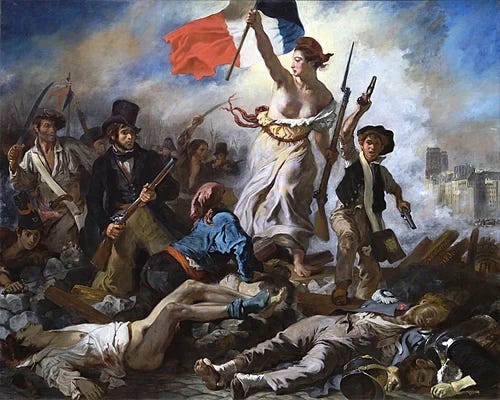
Liberty Leading the People, (Eugene Delacroix, 1830).
Yet this historiographic hostility, while certainly powerful, is less dominant today. The bicentennial of the Revolution and the “End of History” saw the Marxist paradigm diminished in favor of a more flexible interpretive attitude. Studies of revolutionary violence in the Vendee and organized conservative resistance in France sparked ongoing controversy but reflected a more inquisitive stance amongst some in the academy. Serious studies of conservative intellectuals opposed to Revolution have also begun to (still infrequently) appear, with the likes of Richard Lebrun’s and Owen Bradley’s studies of Joseph De Maistre’s life and thought. This shift is long overdue. As Bradley points out, to ignore the conservative response to the Revolution is “to [do] away with half of the terms that make up the problem.” That the Revolution faced physical and intellectual opposition in the first place is integral to its historical importance. Further, as Friedemann Pestel notes, the lack of serious study of the subject thanks to its affiliation with “political reaction, ultraroyalism, or restoration of the Ancien regime distorts or even contradicts the manifold significances contemporaries attributed to counterrevolution.” Dismissing the politically and intellectually diverse opposition the Revolution faced obfuscates not just the roles of conservatives and counterrevolutionaries but hinders a holistic understanding of the Revolution itself.
Nor was the conservative response limited to France. Among the many critics across the Atlantic world, Edmund Burke is only the best-known. In situating conservative responses beyond France, it is useful to revert to (and amend) the trans-Atlantic framework pioneered by R.R. Palmer’s seminal 1959-1964 The Age of the Democratic Revolution. Palmer proclaimed the relative ideological unity of the revolutionary upheaval that swept the Atlantic world between 1760-1800. In his attitudes towards the Revolution’s conservative opponents, Palmer – a Cold War liberal who unashamedly tailored his interpretations to political priorities – was explicitly hostile, dismissing the “extreme right” as a conspiratorial subgroup. Yet his emphasis on a strongly interlinked Atlantic political world is useful in framing how conservatives responded to revolutionary upheaval across that world. Recent historiography assessing “Trans-Atlantic Anti-Jacobinism” has illustrated how conservative information networks ranging across Europe and the United States interacted in opposing the revolutionary “Jacobinism” which had become so acutely tied to domestic politics. Euro-Atlantic conservative thinkers, writers, and publicists drew similar conclusions while watching the French Revolution unfold, critiqued it in light of local contexts, and interacted in their defense of entrenched political orders and Christianity. This should thus serve as the framework of analysis when assessing conservative responses to the French Revolution. How similar were the arguments of conservatives across the Atlantic World? How did local contexts differentiate their conclusions? What, indeed, made them “conservative”? Finally, how does studying them impact the notion of the broader “Age of Atlantic Revolutions”, a concept that even today retains near-hegemonic status in the Academy?
II
If there is one well-known conservative to be found in the study of the French Revolution, it is the conservative: Edmund Burke (1729-1797). The significance of Burke’s thought, while certainly critiqued, is indisputable. Historiography frequently uses him as acknowledgement that principled opposition to the Revolution existed, and his arguments on the primacy of practical considerations over theoretical reasoning in politics is typically used as a stand-in for the conservative position writ large. As such, this essay frequently assesses his impact in the context of how he influenced and compared to other conservative figures across the Atlantic world, but does not independently examine him.
English-language works on Maistre are high quality but limited in quantity. The only comprehensive biography in English remains the 1988 work of Richard Lebrun, the leading Maistre expert in English. Lebrun gained unprecedented access to the Maistre family archives, using tens of thousands of pages of unpublished materials to chart Maistre’s life.
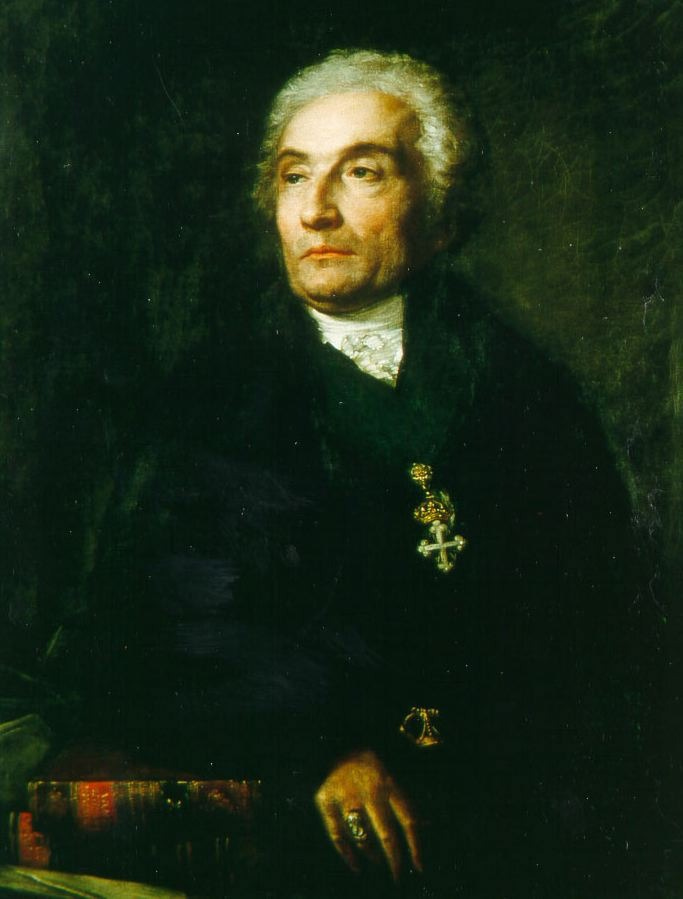
Joseph De Maistre
Of the three figures surveyed, Joseph de Maistre was by virtue of geography and native tongue simultaneously the closest observer of the Revolution and the furthest from the Atlantic networks detailed above. Born in the Kingdom of Piedmont-Savoy (a French speaking part of what is now Northern Italy) in 1753, he was the scion of a bourgeois legal family in a state dominated by the landed nobility. Maistre was thus comparatively liberal by the standards of the regime he served as a jurist. Lebrun characterizes the Maistre of 1788 as an “Enlightened Conservative”, supportive of Necker’s reforms, opposed to royal absolutism, and an admirer of the English constitutional system. A supporter of the calling of the Estates General in the summer of 1788, Maistre was disenchanted with the rapid turn of events by 1790. Maistre soon read Burke’s Reflections, stating in a 1791 letter: “I’m delighted…he has reinforced my anti-democratic ideas…I understand very well how systems… are turned into passions.” The pace of political change, demagoguery, and early violence had dismayed both Maistre and Burke. It would be a further six years before Maistre produced his Considerations on France, a period that saw the French conquest of Savoy force him into Swiss exile.
Considerations makes three key arguments. The first is the overwhelming Providentiality of the Revolution. Maistre argues that the Revolution’s seeming unstoppability is reflective of God’s will to punish, regenerate, and redeem France. The French nobility’s patent admiration of the philosophes, the population’s varied acquiescence and support for the Revolution, and the regicide of Louis XVI is portrayed as a moral stain upon the French, with the “horrible effusion” of blood in the years that followed portrayed through the lens of religious sacrifice as necessary towards the redemption of the French nation. The revolution, then, serves as both punishment and redemption.
Maistre’s second argument returns to the temporal plane. He characterizes the Republic’s chronic instability as intrinsic to its founding, stressing the ahistorical nature of French Republicanism and arguing for the impossibility of durable government to spring from violence, immorality, and corruption. Maistre proceeds to critique the Revolutionary attack on religion. Drawing from Christian and non-Christian history alike, he argues for the impossibility of building a state without drawing from religious concepts and the need to “deify” institutions, which reason alone, “as an essentially disruptive force”, cannot support. The revolutionaries seemed to have reached similar conclusions themselves, and as such, he castigates the artificiality of “philosophism”, defending Catholicism in its stead.
Maistre then attacks the Republican constitution, dismissing the notion that constitutions are created through reasoning and then committed to writing. No constitution, Maistre writes, “is the result of deliberation…in the formation of constitutions circumstances do everything and men are only part of the circumstances.” Maistre wittily observes that in the Republican Constitution of 1795, he sees a constitution made for abstract man - nowhere does he see a constitution for Frenchmen. Lebrun summarizes Maistre’s view: Constitutions are inseparable from “historical, social, and cultural circumstances.” Maistre strengthens this point by stressing the instability and legislative prodigiousness of the Republic, which by this point had discarded two constitutions and issued some fifteen-thousand laws. (Read today, his assessment calls to mind Grant Gilmore’s quip: “The worse the society, the more law there will be. In Hell there will be nothing but law.”) Maistre then contrasts the French experience with that of America’s fledgling Republic, whose institutions, he notes, emerged organically from the colonial experience. Finally, Maistre defends the previous monarchical constitution. Notably, he uses this chapter to defend limits on monarchical power, stressing the roles of the Parlements, estates general, and legal code. Maistre concludes with an assessment of the prospects for counterrevolution, assuring his fellow countrymen of the mercifulness of any royal restoration and accurately predicting its actual course.
Considerations, then, is not merely an explanation and critique of the course of the French Revolution. The significance of Considerations lies in its being the first Francophone work to reject the Revolution “in its principles, as contrary to the very nature of social and moral man” in addition to its circumstantial fruits. Neither is it the embodiment of thoughtless reactionary thought often portrayed in historiography. Maistre treads a cohesive middle ground that contrasts the established, sensible, and even representative principles of the old monarchical constitution with the philosophical shallowness of revolutionary principles. Indeed, Maistre was rebuked by the then pretender to the French crown, Louis XVIII, for his defense of the French Parlements. Furthermore, in tackling the Revolution’s principles head-on, Considerations surpasses Burke’s Reflections in its religiosity and philosophical depth, and rejects the later historiographical separation of Revolutionary ideals and Revolutionary violence. Maistre goes well beyond Burke’s emphasis on practical wisdom in its metaphysical argumentation, rejecting Rousseau’s concepts of popular sovereignty and social contract theory and explicitly tying the organic development of institutions and constitutions to the divine in a way Burke never did. Maistre’s stress on the providential nature of the Revolution is inseparable from his personal background and immediate local context. Maistre was a devout Catholic who was well-versed in theology, writing for a listless, deeply Catholic French emigre community in Switzerland. Considerations made Maistre: the work quickly spread among the emigre community and confirmed him as a leading emigre intellectual.
It is thus testimony to Maistre’s intellectual talents that his critique of the Revolution became the recurrent target of vitriolic historiographical attacks. His characterization in the French academy throughout the 19th and 20th centuries – where his work was used for political ends by left and right alike – was that of a hopeless reactionary and religious sentimentalist alike. As Lebrun charts, a similar tendency remained popular in the English-speaking world up to the end of the Cold War. When recognized as an intellectually worthy opponent of Revolution by Isaiah Berlin, he transformed from a Catholic royalist moderate of the late nineteenth century into the intellectual godfather of fascism. That the furiousness of such responses is a credit to Maistre’s depth as a thinker has been recognized by the post-bicentennial English-language historiography, which has critiqued the explicit historiographic hostility of the past two centuries and Berlin’s transposition of Maistre’s thought into modern categories.
Maistre’s conservatism synthesized general principles espoused by conservatives across the Atlantic world with a distinctly French outlook. Maistre shared with Edmund Burke the commonalities of the conservative response to the Revolution: an unashamed historicism, a rejection of abstract reason as the governing principle of politics, and a strong repudiation of atheism. Both men correctly predicted that the Republic would not survive the instability of its founding. Their divergences reflected the distinctly local contexts they wrote for: when Maistre rejected Burke’s suggestion of an English constitution for France, it was thanks to his appreciation of the circumstances of French history, not an unassailable royal absolutism. Similarly, Maistre’s overwhelming religiosity reflected the reality of conservatism in a nation long known as “the elder daughter of the Church.” The two men shared one further commonality: an acknowledgement of the organic nature of American republicanism. Three years after Considerations, a Prussian pen would take that observation much further.
III
Friedrich Von Gentz opposed the French Revolution on rather different grounds from both Maistre and Burke. A disciple of Kant, a Prussian civil servant, and the later right-hand man of Prince Clemens von Metternich, Gentz would first translate Burke’s Reflections and then use the American Revolution to critique French upheaval through the lens of real right.
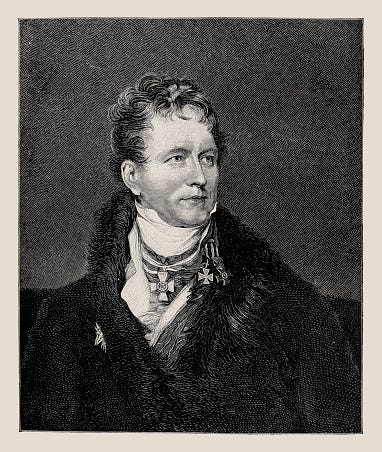
Friedrich Von Gentz
Gentz was born in 1764 to a bourgeois Prussian family. He was educated at the University of Konigsberg, where his studies for the civil service quickly played second-fiddle to his discipleship of Immanuel Kant and study of Montesquieu and Rousseau. Gentz’s philosophical background would profoundly shape his early reaction to the revolution, which he defended in December 1790 as the first “practical triumph of Philosophy…I would regard the failure of this Revolution as one of the worst disasters ever to befall the human race.” In the same year, he defended the “natural rights” of man against a historicist critique in the Berlin newspapers. Yet within a year Gentz was profoundly disillusioned. Part of this reflected his personal background: Gentz was emblematic of a German bourgeoisie that had initially welcomed the French Revolution only to recoil aghast at its progression. The other effect was that of Edmund Burke’s Reflections, which Gentz first read in mid-1791.
Gentz was impressed, but assessed the work through his own intellectual background: he found Burke eloquent and prescient, but insufficiently philosophical. Nor was Gentz willing to abandon his philosophical background. Instead, in undertaking a translation of the Reflections, Gentz synthesized his rationalism with Burke’s practicality, attaching a compendium of his responses to the work. Gentz took creative liberties with the translation to base Burke’s relatively anti-metaphysical concepts on a rational, philosophical basis, transforming Burke’s criticism against the shallowness of metaphysics in politics to one against imprudent attempts at enacting nonetheless admirable metaphysical principles. A note attached to the translation – which was an immediate success, transforming Gentz from a bureaucrat to noted man of letters – reflected Gentz’s conversion: “Reflection and observation have gradually opened our eyes, and we now realise that a little freedom combined with order is better than a great deal without it.” Also attached was an early comparison of the French and the American Revolutions, a theme Gentz would fully develop in 1800.
Comparisons of the French and American Revolutions as a means of critiquing events in France abounded in Germany during the early 1790s. Gentz, however, undertook the most methodical analysis of the conflicts, synthesizing his rationalist intellectual background and newfound conservatism, and wrote with the benefit of a decade’s hindsight. The translation was an instant hit, elevating Gentz’s profile and accelerating his career as a public intellectual.
The Origin and Principles of the American Revolution, Compared with the Origin and Principles of the French Revolution was published in Gentz’s Historisches Journal in April of 1800. Gentz used four criteria to assess the two revolutions: “with regard to the lawfulness of the origin, character of the conduct, quality of the object, and compass of resistance.” These criteria are based on Gentz’s own conscious attempt to reclaim the paradigm of reason away from French excess: “In order to judge their actions…they must be snatched away from the tribunal they have erected for themselves, and placed at another bar, whose laws accord better with the dictates of uncorrupted reason, and the eternal prescriptions of real right.” Peter Koslowski (Gentz’s twentieth century translator) summarizes “real right” as being dependent on “resistance to political action by violence out of proportion to that resistance.” This right is grounded in a firm rationalism that is nonetheless at odds with the abstraction of the French Revolutionaries.
Gentz opens with an acknowledgement of certain superficial similarities between the two revolutions before contextually charting the roots and historically self-reliant nature of the American colonies. He tracks their mostly independent development, Britain’s largely unprotested monopoly on American trade, and Britain’s unprecedented political infringements after the Seven Years War. His first point is that the American Revolution was relatively lawful and grounded on principles clearly grounded in constitutional rights. Gentz notes the colonies were never subject to the jurisdiction of Parliament and derived their sovereignty from the Crown alone, which had respected their parliaments as integral to the balance of powers. Gentz further argues that American resistance to the Crown’s sanctification of parliamentary overreach, was, given the nature of mixed government and British constitution, legally legitimate. The French Revolution could make no such claims. French revolutionaries had violated every legal propriety by grotesquely violating the constitutional order, appropriating rights based on abstract theorizing for themselves, and using them to justify destroying the rights of the other estates and murdering their legal monarch. All of this, Gentz wrote, was justified merely by the abstract “rights of man, a sort of magic spell, with which all the ties of nations and of humanity were insensibly dissolved.”
Gentz then contrasts the natures of the two revolutions. The Americans offered measured responses to British provocations, even acquitting British soldiers after the Boston Massacre. In contrast, the French “displayed an unparalleled example of violence and inexorable fury in attack”, overthrowing the constitution, murdering their king and swathes of opponents and innocents alike, and finally waging war across Europe. Connected to this was Gentz’s third point, which stressed the limited objectives of the American Revolution, which sought only to defend constitutional rights and then independence. In contrast, driven by universal principles, the French Revolution’s objectives came to encompass the monarchy, organized religion, all opposition, and seemingly the world writ large. Gentz concludes by noting the massive internal resistance to the French Revolution and America’s comparative moderation.
Gentz’s response, then, differs considerably from his assessed contemporaries. He avoids Maistre’s religiosity and Burke’s raw practicality. Gentz instead critiques based on reason. Each of Gentz’s criteria of “real right” – lawfulness, conduct, objectives, and internal resistance – assess moderation in relation to justification. The French Revolution thus becomes for Gentz a perversion of natural right, and his work a reclamation of reason. Gentz’s response reflects his background: the use of the American Revolution as a foil reflects a German bourgeoisie that had applauded one revolution and recoiled at the other; his emphasis on reason reflects his grounding in the Enlightenment; and his use of history to synthesize the two reflects his reading of Burke. Gentz’s response is eloquent and clever. Given this, it is surprising that its English-language historiographical coverage is largely limited to translated German works and the commentary of Russell Kirk, twentieth-century American conservatism’s great man of letters.
That would have proven doubly surprising to contemporaries, given The Origins was immediately translated into English by John Quincy Adams, American Minister to Prussia and later the sixth President of the United States. Adams gave the work high praise, stating in his preface that: “it rescues that revolution from the disgraceful imputation of having proceeded from the same principles as that of France. This error has no where been more frequently repeated, no where of more pernicious tendency than in America itself.” Adams’ comment reflected that by 1800, the French Revolution had become inextricably linked to the fractious politics of the early American Republic.
IV
News of the French Revolution was initially enthusiastically received in the United States. It lent credence to American republicanism, and the abolishment of the monarchy in 1792 resulted in large public celebrations. That enthusiasm cooled as events across the Atlantic spiralled and sharply accentuated the emerging Federalist-Republican divide. Alexander Hamilton’s Federalists – who sought to expand the powers of the Federal government, disliked suffrage expansion, and preferred Britain to France – were horrified by the course of the French Revolution. They were sharply opposed by Thomas Jefferson’s Republicans, who largely continued to support the Revolution, sought the diminution of federal power, and portrayed their anti-suffrage Federalist opponents as closet monarchists intent on betraying the Republic. Federalists saw alarming parallels between their “Jacobin” opponents and French revolutionaries: Philadelphia Jeffersonians “set up a model guillotine and demonstrated its operation…Francophiles burned Federalists in effigy, beheaded and exploded dummies of John Jay, and stoned Alexander Hamilton in the street.” The arrival in 1793 of Revolutionary French Ambassador Edmund Genet worsened Federalist anxieties. Genet’s threats to enlist the masses against the American government resulted in his speedy recall, but his mission heightened political tensions (Genet had been welcomed by large celebrations in major American cities.) The fraught political climate of mid 1790s America was thus explicitly linked to events in France. John Adams wrote in 1795, two years before his accession to the American presidency, that the republicans had “adopted the very stile and language of the French Jacobines.”
It was in this atmosphere that the Federalist Noah Webster penned The Revolution in France for his Federalist Magazine, “American Minerva.” Webster’s political evolution mirrored both that of his Atlantic conservative contemporaries and the Federalists writ large. Webster, the son of a farmer, a long-term Federalist and self-made public writer – Webster is best known today for his dictionary and substantial contributions to the development of American English – had initially welcomed the Revolution and defended it as late as the summer of 1793. By mid 1794, his views had changed, driven by the continued course of the revolution, the domestic popularity and aggressive conduct of Genet, and continued anti-Federalist violence as well as the “growth of faction.” Webster feared that unimpeded, American enthusiasm for the French Revolution would bear similar fruits at home: “A king of France and a mob in America have committed equally an outrage on the liberties of others.” As such, Webster aimed to applaud initial French aims while condemning the Revolution’s violent progression.

Noah Webster
The Revolution in France opens with an appeal to American republicans: the author, he declares, “exulted with joy when the revolution in France was announced.” This joy, however, has “been much allayed by the sanguinary proceedings of the Jacobins, their atheistical attacks on Christianity, and their despicable attention to trifles.” Webster’s structure assesses the past of the Revolution to impart lessons for America. Of the three works assessed, Webster’s is by far the shortest, but it nonetheless is remarkable as a microcosm of the conservative, Federalist approach to the Revolution.
The first half of Webster’s work provides historical context, assessing how the Jacobins took power, the terror, and the economic and military consequences of the revolution. He pays particular attention to the overthrow of religion, arguing the revolutionaries merely replaced one superstition – Roman Catholicism – with another, the “Cult of Reason.” He compares this to paganism and decries the resulting unleashing of extremist political “enthusiasm.” This is reflected in public morals - by “exterminating everything that looks like imposing restraint upon the passions”, the French created the necessary conditions for violence and massacres, which Webster proceeds to detail. This “ferocious licentiousness” is blamed not only on the absence of religion but the “virulence of party” and particularly the ascent of faction. The “seeds of faction…sown thick in the present constitution of France” are a primary cause of the political instability plaguing France. It is also a betrayal of the integral values of the Revolution; faction, he stresses, “is death to liberty.” The derailing of the Revolution, then, is the unavoidable consequence of the destruction of religion, the resulting unleashing of men’s passions, and the primacy of faction.
Webster proceeds to impart lessons from France for his American readership. The rejection of “all ancient institutions, civil, social and religious” is a fool’s errand. Men are not capable of moral regulation without “the restraints of religion and law.” Passions drive men towards vice, and vice must be corrected by law and a strong government. Most importantly, “party spirit is the source of faction and faction is death to the existing government.” He directly links factions to the growth of “democratic societies” in the United States, stressing that American reform can only take constitutional form. Webster concludes with a stark critique of French despotism, predicting that the French nation will eventually learn that the despotism of popular passion,“ a despotism, infinitely more terrible than the… tyranny of a monarch”, is no basis for stable government. Echoing Burke, he states that “the conclusion of the whole business, will be that the blood of half a million citizens will compel the nation to renounce the idle theories of upstart philosophers and return to the plain maxims of wisdom and experience.”
Webster’s analysis is inseparable from the political-cultural milieu he published it in. Given the United States’ distance from Europe, it is ironic that American conservatives felt the French Revolutionary threat as acutely as much closer observers such as Maistre and Gentz. Webster’s publication was one amongst many warning of the political, cultural, and religious threats of Jacobinism and its domestic equivalents. Historiographical scholarship has (unsurprisingly) traditionally dismissed these Federalist and conservative portrayals of Jacobin influence as primarily media manipulation. Yet, as Noah Eber-Schmid – who is clearly unsympathetic to conservative concerns – points out, fears of French-style “Jacobin” movements went beyond that of outlandish conspiracy, reflecting also distinct concern on the part of Federalists and conservatives writ large about the role of democratic publics and the potential for mass violence in the young Republic. In so doing, the Federalists appropriated for themselves the mantle of order and lawfulness, and for their opponents that of a passionate and destructive factionalism. The events of the French Revolution, then, had consummated a conservative unease developing since the birth of the Republic. If the American Revolution had left the question of democratic involvement in American politics unanswered, then the events of the French Revolution provided the Federalists with ample justification for their vision of political order.
As such, Webster’s work stands out for its political bluntness: this is a work unequivocally intended to dislodge American admiration for French popular rule. It follows that the general principles which Webster shares with his European counterparts are tapered by a firm Americanism. Webster’s exultation at the dethronement of Louis XVII and the institutional deposition of Roman Catholicism starkly differentiate him from Gentz and Maistre. His emphasis on the dangers posed by the overthrow of morality and faction are assessments of where the Revolution went wrong rather than intrinsic faults. Strong parallels are nonetheless present. “Reason” untempered by religion, morality, and law is no guide to governance. All three men stress the danger of mob passions. Webster’s defense of “ancient institutions, civil, social and religious”, echoes Gentz’s and Maistre’s historicism. Yet the central element is his alone: if Maistre’s analysis is characterized by French religiosity and Gentz’s by German rationalism, then the overwhelming conclusion from Webster is the danger of faction.
V
The conservative figures examined above offered diverse and intellectually sophisticated responses to the French Revolution. Nor were they isolated, sharing practical interactions that transcended borders and oceans. Edmund Burke’s Reflections was referenced favorably by Maistre on multiple occasions. It had more influence on Gentz, who corresponded with Burke and whose translation of the work was one of the driving forces behind his political conversion.
While not referenced in Webster’s published works, Reflections had been printed in the United States by 1791 and achieved immediate popularity among Federalists, making it likely that Webster had read it by 1794. Maistre had little immediate influence in the English-speaking world, but Gentz read Maistre’s Considerations before the two men met in April 1803. In turn, Gentz’s 1800 essay had an immediate reach well beyond his native Prussia: translated by John Quincy Adams, it was published in Philadelphia and circulated widely. Webster’s work is admittedly unlikely to have been read by any of the other figures discussed, but given its overwhelmingly American context, this is unsurprising. Trans-Atlantic conservative interactions extended well beyond the figures assessed previously: even literary works criticizing the Revolution by female British authors such as Hannah More and Helen Maria Williams found a rich reception in the United States. In turn, British conservatives kept themselves equally apprised of developments in France and the progress of “American Jacobinism” through an anti-Jacobin newspaper milieu that extended from London and Philadelphia to Frankfurt and Florence. In short, conservative critics of the Revolution worked within the same eighteenth century constraints of time and space as their radical opponents to engage with and disseminate critiques of the French Revolution.
The core of these critiques – already contrasted at length – were similar across the board: an emphatic rejection of atheism; a warning of the misappropriation of reason and the dangers of unrestrained passion; and the importance of adhering to the political, social, and cultural frameworks provided by historical circumstance. Their differences, varying the exact roles of religion, reason, and republicanism, reflected the national, intellectual, and personal backgrounds of the authors. Significantly, as discussed above, those differences largely did not prevent them from interacting with each other’s works.
Three further similarities not yet mentioned are worth touching on. Maistre, Webster, and Gentz all hailed from bourgeois backgrounds (as did Burke.) Bourgeois upbringings make it less surprising that all three also initially supported political change in France from 1788 until their respective disillusionments. That none hailed from the aristocratic groups that had the most to lose in revolution both strengthens the case for their intellectual honesty and reopens a question of class analysis that recent historiography has largely moved on from. Finally, one shared conclusion signifies their shared importance: they were largely right in predicting the course of the Revolution. Maistre prophesied that the instability of the Republic would prove unsustainable and lead to the eventual restoration of the monarchy; Webster predicted that the enormous bloodshed under the tyrannical “rule of the masses” would result in the re-establishment of a strong executive authority; and Gentz, writing with a decade’s hindsight, was objectively correct that in terms of spilt blood and internal upheaval, the American experience had paled in comparison with the French.
This has two serious historiographical implications. The first is that the conservative response to the French Revolution requires the same attention that its radical counterparts have received. As Jonathan Den Hertog noted in 2013, transnational and transatlantic histories of responses to the French Revolution are far from lacking. In 2025, his analysis remains accurate: from the role of the Haitian Revolution to Thomas Paine, recent studies have consistently furthered the sense that “the Atlantic World…[was] in the throes of radical reconstruction at every level.” Yet Hertog’s next point, and that of Maistre, Gentz, and Webster, remains true. The French Revolution, far from succeeding, devolved into bloodshed and dictatorship. In a similar vein, the efforts of Citoyens Genet and Paine to push the United States in a more progressive direction largely failed. Even the Haitian Revolution – the contemporary locus of academic fawning – ended in despotism. If, then, the conservative intellectuals comprising what Hertog dubs a “transnational political ideology” analysed and successfully rebuffed much of the revolutionary momentum confronting them, then any study of the French Revolution and its Atlantic relations that fails to incorporate conservative resistance is missing crucial historical context. Sadly, a decade after Hertog’s comments, the historiography remains notably sparse in its treatment of this resistance.
The second, more fundamental implication challenges the Atlantic revolutionary paradigm itself. These thinkers are indeed worthy of study. Their analyses of the Revolution were indeed accurate. And they were indeed successful (if in varying degrees) in helping halt the spread of revolutionary ideology. Given these observations, the fact they uniformly differentiated the American and French Revolutions poses a challenge to a historiographical paradigm that generally continues to take the trans-Atlantic revolutionary framework as a given. That, in turn, raises the need for a historiographical reassessment of the American founding. Informed by the thinkers assessed above, those looking for the revolutionary founding of a “creedal nation” should look not to the young American Republic, but eastwards to France. The prolonged and painful failure of that “experiment” bears lessons for our own time.
Reshaping the dominant trans-Atlantic historiographical paradigm is a challenge beyond the scope of this post, but one historians should embrace. American identity remains in unprecedented flux. Putting it on a grounded and organic historical footing is a prerequisite to the “American Revival” so oft-sought by so many.
The academy’s dismissal of conservative intellectuals as mere "fanatics" is a convenient way to ignore the historical failure of the radical projects they critiqued. While the French and Haitian experiments collapsed into despotism and "bloody ruins," these thinkers correctly diagnosed the "pure impurity" of attempting to build a state on abstract reason alone. It is time to admit that the American founding succeeded specifically because it rejected the "magic spell" of Jacobinism that destroyed the French order.